
Blog
Post-Termination Cumulative Trauma Claims: What California Defense Firms Need to Find in the Records
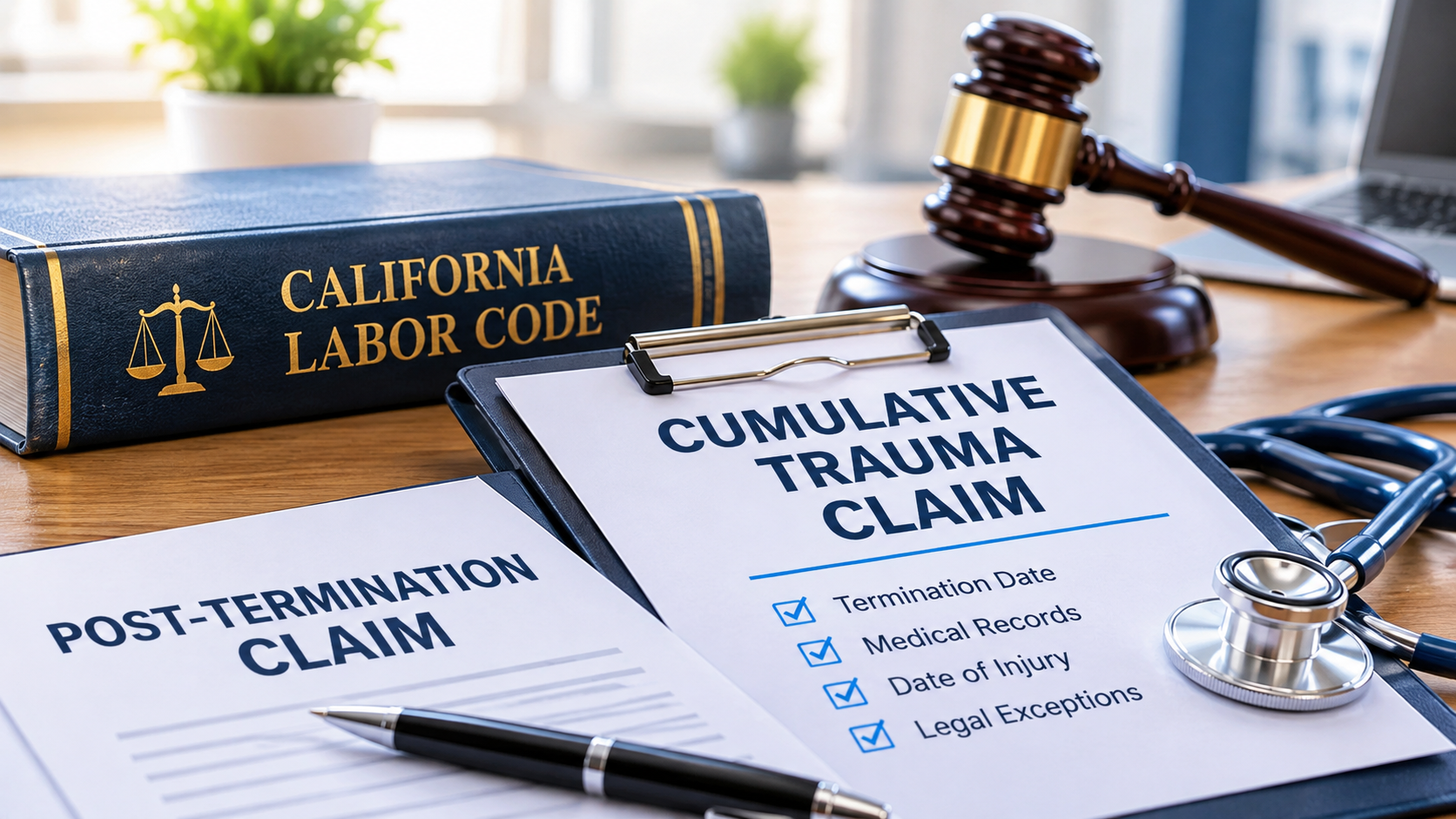
Post-termination cumulative trauma claims in California are a growing share of the caseload. In its study of accident years 2022 through 2024, the WCIRB found 58% of CT claims were filed after employment ended, up from 44% a decade earlier, and that nearly all were litigated. For defense firms, that makes the dates and documents in the file especially important.
Cumulative trauma claims in California are now a significant share of indemnity claims
Unlike a specific workplace accident, cumulative trauma develops over time, which makes it harder to establish when an injury became a compensable claim.
At the WCIRB's July 2026 annual conference, Chief Actuary Tony Milano reported that cumulative trauma accounted for a preliminary 26.6% of indemnity claims in 2024 and 31.6% in 2025, more than double its share fifteen years earlier.
The WCIRB's study, Emerging Patterns of Cumulative Trauma Claims, published June 10, 2026, found 58% of CT claims in accident years 2022 through 2024 were filed after employment ended, against 44% a decade earlier. Nearly all were litigated, according to a summary published by Business Insurance, and CT claims draw medical-legal and interpreter services earlier than non-CT claims.
The pattern is consistent: post-termination cumulative trauma claims move into litigation early, which makes the available records and the dates they establish especially important.
How Labor Code 3600(a)(10) is meant to work
California Labor Code 3600(a)(10) provides that, when a claim is filed after notice of termination or layoff, including voluntary layoff, and the claim is for an injury occurring before that notice, compensation is generally barred unless the employee establishes one of four statutory exceptions.
Exception
What the employee must show
(A) The employer had notice of the injury, under the provisions beginning at section 5400, before the notice of termination or layoff
(B) The employee's medical records, existing before the notice of termination or layoff, contain evidence of the injury
(C) The date of injury under section 5411 falls after the notice of termination but before it takes effect
(D) The date of injury under section 5412 falls after the notice of termination or layoff
Timing and available evidence are central. For a specific injury the relevant history is usually easier to identify. For cumulative trauma, the date-of-injury rules under section 5412 complicate it.
Section 5412 can create a path through the post-termination bar
Section 5412 fixes the date of injury for a cumulative injury as the date the employee first suffered disability from it and either knew, or in the exercise of reasonable diligence should have known, that the disability was caused by present or prior employment.
Two elements, and the later controls. Neither disability nor knowledge alone establishes the date of injury; it is fixed when both are present.
Consider a common pattern: a worker lives with pain for years without seeking treatment or connecting it to the job. After employment ends, a doctor tells them the condition may be work-related. Depending on the evidence, both disability and knowledge may fall after the termination notice, bringing the claim within exception (D).
This does not make the post-termination bar irrelevant. It means the defense turns on the dates, and those dates have to be established through documents rather than recollection.
Four places the file can come apart
The same gaps recur across cumulative trauma claim records in post-termination matters.
No document fixing the notice date.
Every exception is measured against the date of the notice of termination or layoff. Where that date exists only as a recollection or an HR summary, nothing downstream can be measured against it.
A pre-notice medical record from one treating provider only.
Exception (B) asks whether records existing before the notice contain evidence of the injury, which cannot be assessed from a partial file. The relevant history often sits with a personal physician nobody has identified.
A disability date assumed from treatment rather than established.
Disability under section 5412 has a specific legal meaning. A first appointment, a doctor's note or modified duty does not automatically establish compensable disability. The file needs records showing ability to work, any wage loss, and the medical basis for the claim.
A knowledge date left to the evaluator.
Without the first document connecting the condition to the work, the evaluator relies on the history the worker gives at the examination. Earlier records, emails or employer communications may establish when the worker first knew, or should have known.
Each involves finding and organizing records before conclusions are drawn. The case below shows how closely the outcome can turn on the dates documented in the file.
In Gonzalez, one day decided the date of injury
A process technician called his doctor's office on October 7, 2020, about right shoulder pain and was given the first available appointment, October 15. His supervisor called on October 8 to say his employment would end on the 12th. On October 9 he emailed several people at the company about the termination, connecting the shoulder pain to a work injury from around September of the previous year.
Knowledge therefore fell one day after the notice, and compensable disability six days after that. Because section 5412 takes the later of the two, the date of injury was October 15. Exception (D) applied, and the Workers' Compensation Appeals Board denied reconsideration on September 15, 2023, in Gonzalez v. Lam Research Corporation, ADJ14380906.
Four documents decided those dates. The worker's own email, admitted as a defense exhibit, fixed knowledge at October 9, while his supervisor testified he had never reported a work injury to her. A work-status slip claiming total disability from November 2019 was rejected, because he had kept working without restriction. A second doctor's records showed his July 2020 absence was COVID-related rather than shoulder-related. And an EDD certification from March 2021, together with an employer-issued Attending Physician Statement, fixed disability at October 15.
A fifth document matters for exception (B). The worker's personal physician of ten years had no record of shoulder complaints at all, an absence visible only because those records had been obtained.
The defense is assembled from records, and records have to be chased
Nothing in Gonzalez rested on theory. Every date was assessed from documents created before anyone was preparing for trial, several held by third parties.
That is where disciplined workers' compensation medical records retrieval can support a California defense team. EWORD Solutions helps firms obtain and organize medical records for workers' compensation defense through subpoena and authorization preparation, provider follow-up, retrieval, and quality checks. Retrieved records can be OCR-processed and checked for completeness. Through its Medical Records Review service, EWORD organizes records by provider and date, hyperlinks them, and prepares summaries.
A complete provider record helps counsel assess whether pre-termination medical evidence exists, and chronological organization makes it easier to trace when symptoms, work restrictions, disability and causation first appear. Whether a statutory exception applies remains a determination for counsel.
For an open post-termination cumulative trauma claim, three questions. Is the termination notice date documented in the file? Does the pre-notice medical history cover every provider, or only those the parties identified? Can you name the first document in which disability and work-related causation each appear?
If any answer is unclear, there is a records gap worth closing before the defense position is assessed.
Talk to EWORD about records retrieval for cumulative trauma files
Post-termination cumulative trauma claims in California are a growing share of the caseload. In its study of accident years 2022 through 2024, the WCIRB found 58% of CT claims were filed after employment ended, up from 44% a decade earlier, and that nearly all were litigated. For defense firms, that makes the dates and documents in the file especially important.

For California workers' compensation defense firms, a records retrieval request marked "received" can still be missing months of treatment history. Discovery generally closes at the mandatory settlement conference (MSC), and two 2025 decisions show how strictly that cutoff is enforced. A dated retrieval history and a clear handoff to counsel give the legal team time to act on gaps while options still exist.

The legal document workflow runs through six stages, and electronic filing is one of them. This post sets out what each stage produces, what counts as proof that it happened, why California regulation places the burden of that proof on the filer, and where service obligations continue after a document reaches EAMS.